
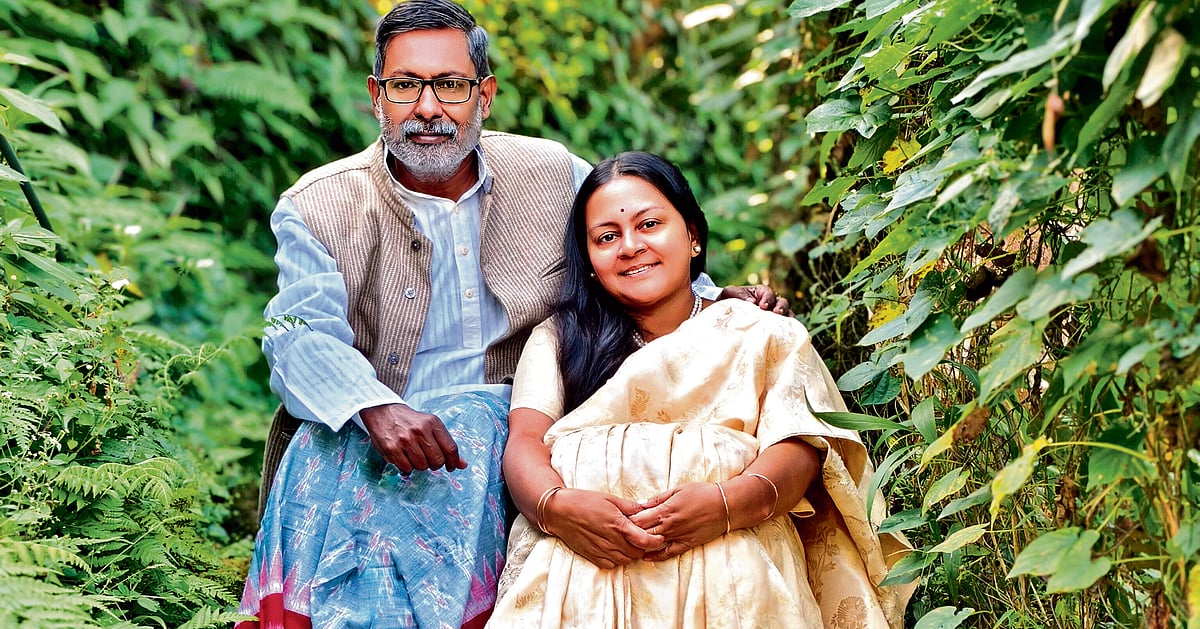
On a blistering July afternoon in Shantiniketan, guests gather beneath the terracotta eaves of a pale, eggshell-hued bungalow. A breeze stirs through the trees, carrying with it the scent of mango flower sherbet and slow-cooked rice. Inside the sunlit kitchen, shrimps are being gently steamed into dumpling-like pithe, coconut milk simmers quietly on the stove, and the stories flow as generously as the courses to come.
For Shuli Ghosh, co-founder and creative head of Sienna Calcutta, the experience was far more than just a meal. “As soon as we arrived, we were greeted by Amrita di’s warm smile and her airy cotton handloom sari,” she recalls. “It was the storytelling—between Amrita di and her elder son, Tiyash, as they prepared each dish in that sun-dappled kitchen—that opened me up to new ways of thinking about food, and life.”
Five years ago, Amit Sen and Amrita Bhattacharya left behind their 35th-floor duplex in Kolkata for a quiet farmhouse in Shantiniketan, trading skyline views for a patch of fertile earth. What began as a personal reinvention has since grown into a quiet radical culinary movement—one that pieces together Bengal’s migratory histories through recipes and oral traditions.
Forty-year-old Bhattacharya, a former college professor and Fifty-nine-year-old Sen, a filmmaker, now refer to themselves as “self-taught food anthropologists.” From their bucolic base—complete with rice paddies, a freshwater pond, and a thriving kitchen garden—they host intimate pop-ups grounded in memory, storytelling, and the layered flavours of Bengal’s forgotten kitchens.
The transition began during the pandemic. “She never imagined leaving academia,” Sen says. “Once we built this home and chose to stay, Amrita tried to secure a transfer to nearby colleges, but it didn’t work out. So she began tending to the land, growing food, and making pickles.”
That modest act of pickling, sparked something bigger. Their first pop-up, held in Mumbai in 2021, was unplanned. “I just started making pickles,” Bhattacharya shrugs. But with encouragement from their son Tiyash, their quiet kitchen evolved into a cultural archive.
Much of their work explores the culinary legacies of displaced Bengali communities—from post-partition migrants in Tripura and the Andamans to Portuguese-Bengali hybrids in Midnapore.
“We examine how history—colonialism, Maratha invasions, indentured labour—scattered people across geographies. And how food travelled with them,” Sen explains.
For instance, in Mahishadal, a small town in East Midnapore, they uncovered the story of 16th-century Portuguese mercenaries who settled and intermarried with locals. “They formed a unique micro-community,” says Sen. “Their vindaloo, for example, is nothing like the Goan version—it’s its own thing entirely.”
For Bhattacharya, whose family hails from East Bengal, the research is deeply personal. “My own story is one of migration,” she says, adding “Food memory is often the last thing we cling to when everything else is lost.”
Their research method is as intimate as it is immersive. When travelling, the couple steers clear of downtown hotels and Airbnbs. “We look for homes run by elderly women in quieter neighbourhoods,” Sen says. “Staying with them, you build trust. Eventually, they open up.”
One of their most unexpected finds was a Burmese-style hilsa dish: pressure-cooked with lemongrass and fish sauce, bearing no resemblance to the mustard-laden versions so beloved in Bengal. “It was a cultural shock,” Bhattacharya laughs. “But we tried it—and it has become one of our favourite”
Their travels are relentless. In May, they visited Bengali communities in Amritsar—descendants of janitorial workers brought there during the British Raj. In June, they explored culinary traditions among the Basak weaving community near the Bangladesh border. Each time, the couple comes back not just with stories of migration but with seeds, rare rice strains, and even local utensils.
Their pop-ups, hosted at home, are intimate affairs. A 13 or 14-course tasting menu is served in carefully chosen vessels—bell-metal thalis from Assam, tribal earthenware, or traditional copper plates. Each menu is shaped by season, travel, and the vagaries of the local market.
Despite being a filmmaker and repeated suggestions to document their journey, sen has no plans to document the journey. Instead, the couple is working on a series of graphic novels chronicling their travels and the food.
As with everything in their lives now, the writing, the meals, the travel—all of it springs from a shared impulse: to preserve, reimagine, and celebrate the fluid, ever-evolving story of Bengal—one plate at a time.


